How to Make Shaved Ice at Home, With or Without a Machine
August 27, 2026
The whole method: freeze a solid block of filtered water for a day, temper it 10 to 15 minutes until the surface turns glossy, shave it into thin sheets with a rotary shaver or food processor, mound it loosely, and top with 1 ounce of syrup per serving.
That glossy-surface pause is the step almost everyone skips, and it is the difference between fluffy snow and crunchy granules. This guide walks through the full process, compares five ways to shave the ice, and gives you syrup ratios that actually measure out.
What Counts as Shaved Ice (and Why Crushed Ice Isn’t It)
Shaved ice is cut, not smashed. A blade planes the block into sheets so thin they pack like fresh snow, absorb syrup evenly, and melt the moment they touch your tongue. Crushed ice is the opposite: hard little chunks with gaps between them, so syrup drains through and collects at the bottom of the cup. That single difference in geometry is why a snow cone needs a straw and shave-ice stands hand you a spoon.
The world’s ice desserts are variations on that idea:
| Style | Base | Texture | Typically served with |
|---|---|---|---|
| Hawaiian shave ice | Water block | Fine, snow-like | Fruit syrups, condensed-milk snow cap |
| Kakigori (Japan) | Water or mineral-water block | Feather-light, delicate | Matcha, fruit, sweetened condensed milk |
| Bingsu (Korea) | Frozen milk base | Creamy flakes | Sweet red beans, fruit, mochi |
| Taiwanese snow ice | Flavor frozen into the block | Wide silky ribbons | Fruit, drizzles |
| Snow cone | Crushed cubes | Coarse, crunchy | Syrup poured over the top |
Every one of the first four starts with the same three fundamentals: the right block, the right temperature, a real blade.
Step 1: Freeze the Right Ice
Cube-tray ice is the wrong starting point. Cubes freeze fast from all sides, which traps air and minerals in the middle; the cloudy centers shatter into grit, melt quickly, and won’t hold toppings. You want one dense, clear block.
- Use filtered or boiled-and-cooled water. Fewer dissolved minerals and less air mean clearer, harder ice that shaves into even sheets.
- Freeze in a container. A round food-storage bowl or quart container that fits your shaver’s chamber works. Fill to about a half inch below the rim; ice expands.
- Give it time. At least a full 24 hours. Commercial kakigori blocks are frozen slowly at around 5 to 10°F for days, and the same principle applies at home: slower freezing makes denser ice.
- Sweet trick from the islands: some Hawaiian stands stir a little sugar into the water before freezing. Sugar lowers the freezing point slightly, and the finished ice shaves softer.
- Milk variant: freeze sweetened milk (condensed milk whisked into whole milk) in the same containers for a bingsu-style cream ice.
One block from a typical round bowl yields around 10 servings, so freeze two or three ahead of a party and keep them bagged in the freezer.
Step 2: Temper the Ice Before You Shave
Ice straight out of a home freezer sits near 0°F. At that temperature it is brittle glass: the blade chips it into coarse, scratchy crumbs, and a hand crank or motor has to fight it the whole way.
Set the block on the counter for 10 to 15 minutes and let it warm to around 18 to 20°F. You don’t need a thermometer; watch the surface. When the frosty white bloom turns glossy and just barely wet, the ice is ready. It now shaves in continuous soft sheets instead of snapping, and the blade lasts longer too.
Too far in the other direction is also real: ice left out too long shaves wet and slushy and collapses under syrup. Glossy, not dripping, is the cue.
Step 3: Shave It. Five Methods Compared
| Method | Texture you get | Effort | Batch size | Cleanup |
|---|---|---|---|---|
| Manual rotary shaver | Fine, fluffy snow | Low: crank a handle | Continuous | Rinse under the tap |
| Electric shaver | Fine, fluffy snow | Lowest | Continuous | More parts, hand-wash |
| Food processor (shredding disc) | Small flakes, close to snow | Low | ~2 cups cubes per batch | Bowl, lid, disc |
| Blender | Fine slush, drink-grade | Low | 1 to 2 cups per batch | Jar and blade |
| Freezer bag + rolling pin | Crushed ice (snow cone) | High | One bag | None |
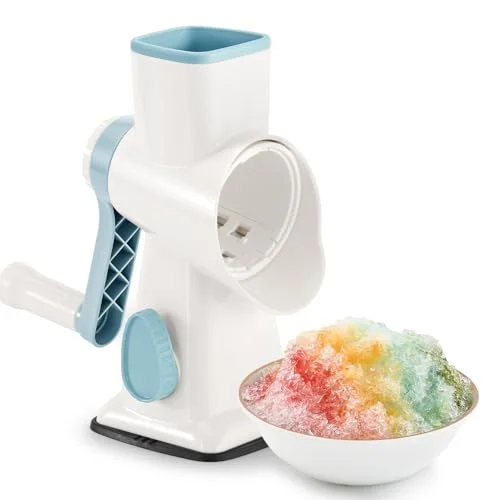
Two useful truths hide in that table. First, hand-crank and electric shavers tie on texture; people who shave ice for a living confirm the motor only adds speed. For a family kitchen, a manual rotary shaver like the KEOUKE Rotary Ice Shaver hits the sweet spot: 16 stainless steel blades do the planing while a suction base holds the drum to the counter, and the whole thing rinses clean and goes back in a cabinet.
Second, the no-machine hacks make a different dessert. A food processor with a shredding disc comes respectably close: drop in about 2 cups of cubes, pulse, and check at the one-minute mark for a snowy pile. A blender makes excellent slush for frozen drinks but purees rather than shaves. And the freezer-bag-and-rolling-pin routine (wrap the bag in a dish towel so it doesn’t tear, whack until the pieces hold together slightly when pressed) produces classic snow-cone ice: fun, crunchy, and nothing like shave-stand snow.
With a rotary shaver, the routine is: temper the block, load it into the chamber, press the suction feet onto a smooth counter, set a chilled bowl underneath, and crank clockwise with steady, light pressure. Steady beats fast; let the blades set the pace.
Step 4: Syrup Math That Actually Works
Skip the guesswork; syrup is a ratio, not a recipe.
- Base: 1:1 simple syrup. Equal parts sugar and hot water, stirred until the sugar dissolves, then cooled. Want it thicker and sweeter per pour? Go 2:1.
- Flavor, route A: replace the water with fruit juice, or simmer chopped fruit or jam with the syrup and strain.
- Flavor, route B: flavor concentrates, dosed at roughly 1 ounce per quart of simple syrup (4 ounces per gallon). Mix, bottle, label; concentrates stain.
- Serving dose: about 1 ounce of syrup per 6 ounces of shaved ice. A quart of finished syrup covers roughly 30 servings.
- Storage: refrigerated squeeze bottles keep for weeks, and squeeze bottles make the pour controllable.
For a snow cap, keep one squeeze bottle of sweetened condensed milk in the fridge next to the syrups.
Step 5: Assemble It Like a Shave-Ice Stand
- Chill the cups or bowls first; warm dishes melt the bottom layer instantly.
- Mound the ice loosely. Never pack it down; the fluff is the product. It should barely hold its shape.
- Poke a small pocket in the center, then pour syrup in a slow spiral around the outside edge and finish down the middle, so it soaks through instead of pooling.
- For tall servings, push a wooden skewer down the middle before syruping; the channel carries syrup to the bottom of the cup.
- Top it: condensed-milk snow cap, mochi pieces, sweet red beans, fresh fruit, or a scoop of vanilla ice cream hidden at the bottom, Hawaii-style.
Serve immediately with a spoon. Shaved ice waits for no one.
Troubleshooting
- Gritty, crunchy shavings: ice too cold. Temper 5 more minutes and try again.
- Wet, slushy shavings that collapse: ice tempered too long, or the room is hot. Return the block to the freezer for 10 minutes.
- Syrup sitting at the bottom: ice packed too tight, syrup poured too fast, or the ice is crushed rather than shaved. Loosen the mound and pour in a spiral.
- Melts before you finish: cloudy cube-tray ice. Switch to a slow-frozen filtered-water block.
- Crank suddenly feels hard: the block is under-tempered or refroze to the chamber. Pause a few minutes and let it gloss.
One hygiene note worth taking seriously: the FDA Food Code treats ice as a food. Use a clean scoop rather than hands or a glass, wash the shaver’s parts by hand after each session (keep the blade assembly out of the dishwasher), and let everything dry before storing.
How We Sourced These Numbers
- Shaved-ice equipment suppliers, ice tempering guidance and syrup dosing: the 18 to 20°F shaving temperature, the 10 to 15 minute temper window, and commercial simple-syrup ratios and per-serving dosing.
- Eater, the at-home kakigori guide: working shave-ice professionals on manual versus electric texture parity, clear-block ice, and why cube-tray ice fails under toppings.
- KitchenAid, shaved ice vs. snow cone: the texture distinction between shaved sheets that absorb syrup and crushed ice that drains it.
- Kakigori (Wikipedia): the history of the Japanese style and its pure-water, tempered-block tradition.
- FDA Food Code: ice is regulated as a food, which sets the sanitation bar for scoops and shaver parts.
Where a spec varied between sources (temper times shift with room temperature and block size), we give the range rather than a single number.
Frequently Asked Questions
What is the difference between shaved ice and a snow cone?
Texture. Shaved ice is cut into paper-thin sheets that pack like fresh snow and absorb syrup, so every bite carries flavor. A snow cone is crushed ice: hard granular chunks that syrup drains straight through to the bottom of the cup.
Can you make shaved ice without a machine?
Yes, three ways. A food processor with a shredding disc gets closest to real shaved ice: feed in about 2 cups of cubes at a time and pulse for about a minute. A blender makes finer slush that works for drinks. The freezer-bag-and-rolling-pin method makes crushed ice for snow cones rather than true shaved ice.
What kind of ice is best for shaved ice?
A solid block frozen from filtered or boiled water. A dense, clear block shaves into even sheets, while cloudy cube-tray ice is full of trapped air, shatters into gritty crumbs, and melts fast under syrup. Freeze the block for at least a full day, and longer if your freezer allows.
Why is my shaved ice crunchy instead of fluffy?
The ice is almost always too cold. Straight from a freezer at around 0°F, ice is brittle and breaks into coarse crumbs instead of shaving into sheets. Let the block sit at room temperature for 10 to 15 minutes until the surface just turns glossy, then shave.
How do you make syrup for shaved ice?
Start with 1:1 simple syrup: equal parts sugar and hot water, stirred until dissolved and cooled. Flavor it with fruit juice, or use a flavor concentrate at roughly 1 ounce per quart of simple syrup. Finished syrup keeps in the refrigerator for weeks.
How much syrup goes on one serving of shaved ice?
About 1 ounce of syrup for a 6-ounce serving of ice is the standard at commercial stands. Pour slowly around the edges first, then finish over the center, so the syrup soaks in instead of pooling at the bottom.
Is a manual or electric ice shaver better?
For texture, they tie: professional shave-ice makers point out that a hand-crank shaver produces the same fine sheets as an electric one. Electric is faster for big batches; a manual rotary shaver is cheaper, quieter, easier to clean, and stores in a cabinet.
Is it shave ice or shaved ice?
Both are correct. In Hawaii it is called shave ice (and ice shave on the Big Island); most of the mainland says shaved ice. The treat is the same.
Ready for snow-soft shaved ice?
KEOUKE Rotary Ice Shaver: 16 stainless steel blades, a hand crank that takes little effort, and a suction base that locks to the counter. Rinses clean in seconds.
Shop on Amazon